


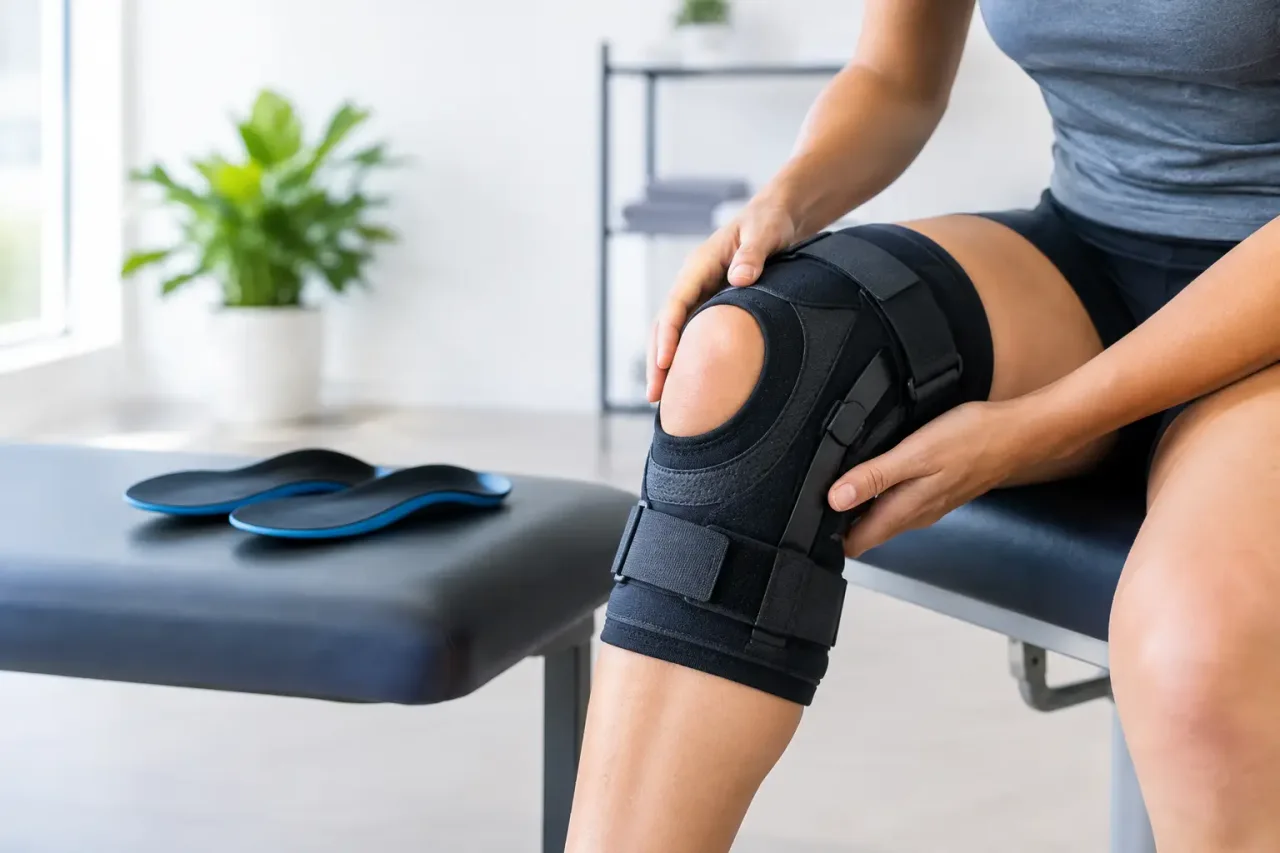
Orthotics for Knee Pain Example Explained
A person may feel knee pain with every stair, run or long walk, yet have no obvious problem at the knee itself. An orthotics for knee pain example can help explain why: the foot is the first part of the lower limb to meet the ground, and its movement can influence forces travelling through the ankle, shin, knee and hip. That does not mean every painful knee needs an insole. It means the source of the problem should be assessed properly before treatment is chosen.
Orthotics are devices worn inside footwear to alter support, pressure distribution or the way the foot moves during walking and activity. For the right patient, they can form a useful part of a wider plan for knee pain. For the wrong patient, a generic insert may be uncomfortable, ineffective or simply distract from the true cause.
When foot mechanics can affect knee pain
The knee does not work in isolation. During walking or running, the foot, ankle, knee and hip all need to control load in a coordinated way. If the foot rolls in excessively, is unusually stiff, or cannot provide a stable base at the right time, the lower leg may rotate differently. In some people, this can increase stress on structures around the kneecap or along the inside or outside of the knee.
This relationship is individual. Many people have flat feet and no pain at all; others have high arches, limited ankle movement or a previous ankle injury that changes how they load the leg. The relevant question is not whether a foot looks flat or pronated. It is whether the person’s symptoms, movement pattern, footwear and clinical findings suggest that foot function is contributing to the knee complaint.
Orthotics may be considered where knee pain is linked with symptoms such as recurrent pain around the kneecap, pain during running, discomfort when descending stairs, or lower-limb overload after a change in training volume. They are less likely to be the main answer where the knee is swollen, locked, unstable after trauma, or painful at rest. Those features require appropriate medical assessment.
Orthotics for knee pain example in practice
Consider a recreational runner who develops aching at the front of one knee after increasing from two to four runs a week. The pain is most noticeable on hills, stairs and after sitting with the knee bent for a long period. They have no single traumatic incident, but the discomfort is beginning to alter their stride.
During assessment, the clinician first considers the whole picture: training changes, footwear age and type, previous injuries, work demands, hip and calf strength, ankle range of motion and the precise location of pain. The runner is then assessed standing, walking and, where appropriate, during functional movements such as a squat, step-down or single-leg balance.
In this example, the runner may show a combination of limited ankle dorsiflexion, reduced control through one leg and a foot that rolls inward quickly after heel contact. This does not prove that the foot is the sole cause of the knee pain. It does, however, provide a reasonable clinical basis for trying an orthotic designed to give more controlled support beneath the rearfoot and arch, while maintaining comfort in the running shoe.
The orthotic is only one part of the plan. The runner may also need a temporary reduction in hill running, a progressive return to distance, calf mobility work and strengthening exercises for the quadriceps, gluteal muscles and lower leg. The aim is not to hold the foot rigid. It is to reduce an aggravating load while the person improves their capacity to run.
A review after a defined period is essential. If symptoms are improving and the orthotics are comfortable, the plan can progress with activity. If pain is unchanged, the diagnosis and treatment strategy should be reconsidered rather than repeatedly altering an insole without a clear reason.
What a proper orthotic assessment should include
A well-made orthotic starts with diagnosis, not a mould or a scan alone. At South London Foot Clinic, the consultation-led approach is designed to identify what is causing symptoms before a treatment pathway is agreed.
For knee-related concerns, a podiatry assessment may include discussion of the onset and behaviour of pain, previous injuries, activity levels, footwear and relevant medical history. Examination looks at foot posture, joint movement, muscle and tendon function, areas of tenderness and how the lower limb behaves in weight-bearing tasks. If symptoms also involve the foot, ankle or lower leg, diagnostic ultrasound may be used where clinically indicated to assess relevant soft-tissue structures and guide treatment planning.
The assessment should also establish what an orthotic is intended to achieve. A device might be prescribed to improve stability in a shoe, redistribute pressure from a painful foot area, accommodate a fixed foot shape, or modify a movement pattern that appears to contribute to overload higher up the leg. These are different objectives and require different designs.
Custom orthotics versus shop-bought insoles
An off-the-shelf insole can be a sensible first step for some people, particularly where symptoms are mild, footwear is roomy and the aim is basic cushioning or arch support. A quality prefabricated device may also help a clinician test whether additional support changes symptoms before making a custom prescription.
Custom orthotics are more appropriate when foot shape is unusual, symptoms are persistent, there is a clear need to control or accommodate a specific area, or standard devices have not been tolerated. They can be tailored to the person’s footwear, activity and clinical findings. A device for a work shoe will not necessarily suit a narrow running shoe, and an orthotic for walking may need different properties from one intended for court sport.
Custom does not automatically mean better. The value comes from a precise prescription, suitable materials and review of the patient’s response. A very firm device may offer more control but be difficult to tolerate. A softer device may feel comfortable but provide less lasting support. The right balance depends on the diagnosis and the person wearing it.
Wearing orthotics without creating new problems
Even a well-prescribed orthotic needs a gradual introduction. Most people benefit from wearing it for short periods initially, then increasing use as comfort allows. A sudden full day in a new device can cause temporary foot, calf or leg discomfort, especially if the body is adapting to a meaningful change in support.
Footwear matters. Orthotics need enough depth, a stable heel counter and a removable insole where possible. Trying to force a supportive device into a shallow or worn-out shoe commonly leads to rubbing, crowding or poor fit. Patients should bring their usual shoes to assessment where practical, particularly the pair used for the activity that brings on pain.
New or worsening knee pain should not be pushed through simply because an orthotic has been issued. Persistent discomfort, altered sensation, rubbing, marked calf pain or a change in symptoms should be reviewed. Adjustments are often straightforward, but they should be based on feedback and examination rather than guesswork.
When orthotics are unlikely to be enough
Knee pain can arise from joint irritation, ligament or meniscal injury, osteoarthritis, inflammatory conditions, referred pain, tendon problems or training errors that no insole can correct on its own. Orthotics are not a replacement for rehabilitation, load management or medical investigation when these are needed.
Seek prompt assessment after a significant twist or fall, if the knee gives way, locks, becomes hot or substantially swollen, or if there is calf swelling, unexplained redness, fever or severe pain. These symptoms may need urgent medical attention.
For longer-standing pain, a structured assessment gives the best chance of avoiding trial-and-error treatment. If foot mechanics are part of the problem, orthotics can be used thoughtfully alongside rehabilitation and realistic changes to activity. The most helpful device is not the most rigid or expensive one; it is the one prescribed for a clear clinical reason, fitted to the right footwear and reviewed as recovery progresses.


