


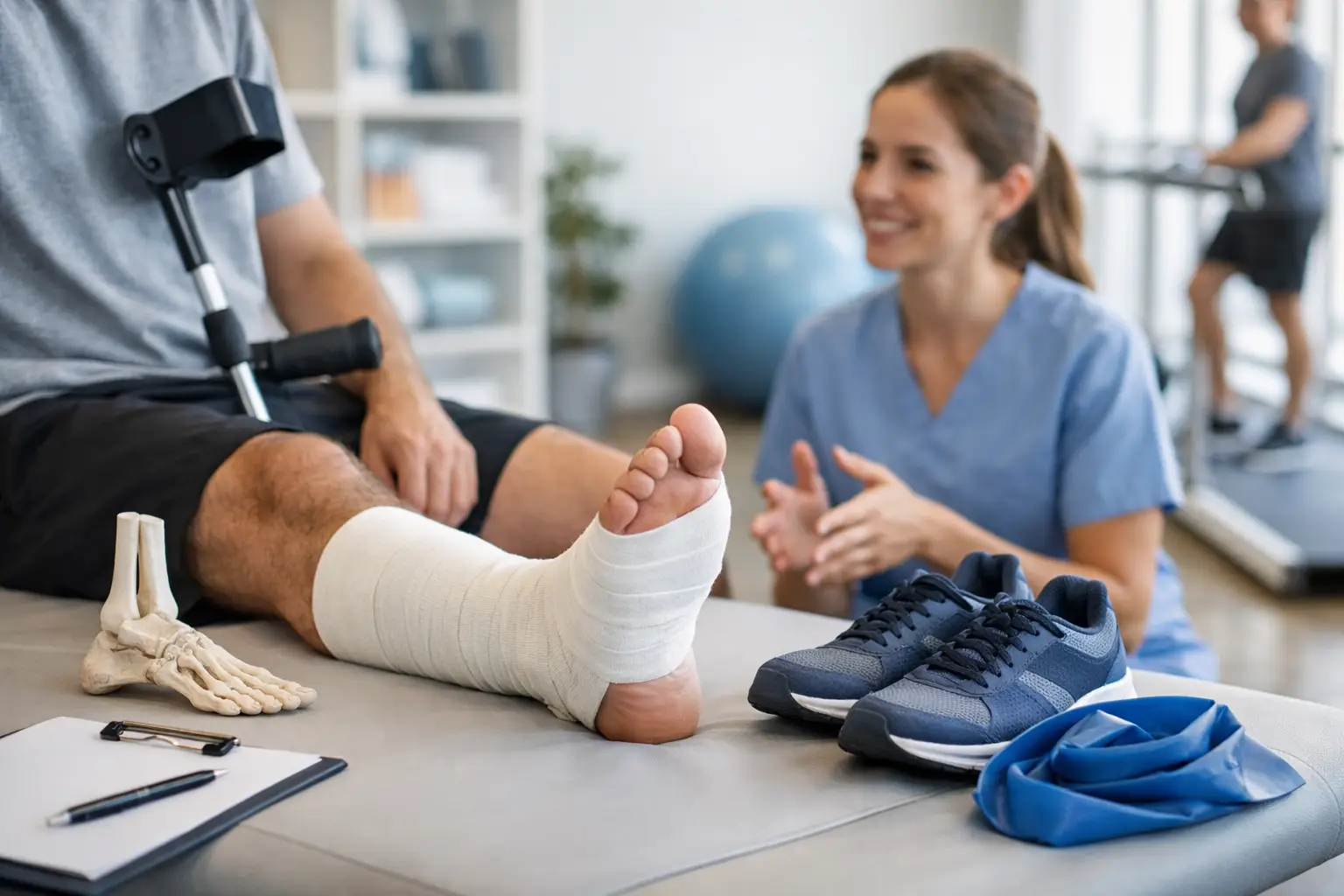
A Clear Plan for Rehabilitation After Foot Injury
A foot injury can appear to settle long before the tissues are ready for normal walking, work, exercise or sport. Effective rehabilitation after foot injury is therefore not simply a matter of resting until pain improves. It is a structured process of establishing what has been injured, restoring movement and strength, then increasing load at a pace the foot can tolerate.
For many people, the most frustrating stage is the period after the initial swelling or sharp pain has reduced. You may be able to walk, but still limp by the end of the day, feel unstable on stairs or notice pain when returning to running. These are useful clinical signals, not a reason to push through. Recovery should be guided by your diagnosis, symptoms and functional progress.
Start with a clear diagnosis
The same area of pain can arise from very different structures. Pain around the outside of the foot may involve a ligament sprain, peroneal tendon irritation, a stress injury or a fracture. Heel pain after a sudden increase in activity may involve the plantar fascia, but could also reflect irritation of a tendon, joint or nerve.
That distinction matters because the right rehabilitation plan depends on the tissue involved and the stage of healing. Continuing to load a suspected stress fracture, for example, is very different from gradually strengthening after a mild ankle sprain. A generic set of exercises may be unhelpful or, occasionally, delay recovery.
A clinical assessment should consider how the injury happened, where symptoms are felt, whether there was swelling or bruising, your walking pattern, joint movement, strength and the demands of your work or sport. Diagnostic ultrasound may be appropriate when a tendon, ligament or soft-tissue structure needs closer assessment. Imaging is not required for every injury, but when it is clinically justified it can help explain the cause of pain and direct treatment planning.
The stages of rehabilitation after foot injury
Healing is not always linear. Symptoms can fluctuate with activity, footwear, sleep and time spent standing. However, a structured pathway usually moves through the following stages.
Protect the injured area without becoming inactive
In the early phase, the aim is to avoid aggravating the injury while maintaining as much safe movement as possible. This may involve modifying activity, using supportive footwear, temporarily reducing walking distance or using a boot, brace or crutches where advised.
Complete rest is sometimes necessary, particularly when a fracture or significant tissue injury is suspected. More often, the goal is relative rest: reducing the activity that provokes symptoms while keeping the rest of the body active within safe limits. Cycling, swimming or upper-body exercise may be suitable for some patients, but this depends on the diagnosis and should not cause increased pain during or after activity.
Pain relief measures can be useful, but they should not be used to mask symptoms so that you can return to high-impact exercise too early. If pain is worsening day by day, it is sensible to reassess rather than simply add more treatment.
Restore normal movement and walking mechanics
After injury, stiffness can develop in the toes, foot, ankle or calf. You may also unconsciously alter the way you walk to avoid pain. This protective pattern is understandable, but if it continues it can place extra load on the other foot, knee, hip or lower back.
Rehabilitation often begins with gentle range-of-motion work and a gradual return to a normal heel-to-toe walking pattern. The appropriate exercises vary. Someone recovering from a forefoot injury may need attention to toe movement and push-off, while an ankle injury may require work on ankle mobility and calf flexibility.
It is generally reasonable for exercise to cause mild awareness of the recovering area, but sharp pain, increasing swelling or a more pronounced limp afterwards suggests the load is too high. Symptoms later that evening and the following morning are often more informative than how the foot feels in the first few minutes of an exercise session.
Build strength, control and tolerance to load
The foot works with the calf, ankle, hip and trunk during every step. For that reason, rehabilitation should not focus only on the painful spot. Strength and control through the whole lower limb can affect how forces are distributed through the foot.
Early strengthening may include controlled calf raises, toe exercises, resistance work for the ankle and simple balance tasks. As tolerance improves, the programme can progress towards single-leg work, uneven surfaces, step-downs and direction changes. For runners and court-sport athletes, this eventually needs to include hopping, landing and sport-specific drills.
The correct progression is individual. A person who stands for eight hours at work needs a plan that accounts for occupational loading. A runner training for an event may need to reduce mileage while preserving fitness through lower-impact exercise. Someone with diabetes, inflammatory arthritis, poor circulation or reduced sensation requires particularly careful assessment because healing and skin protection can be more complex.
Why footwear and orthotic support can matter
Footwear is part of rehabilitation because it changes how the foot is loaded throughout the day. A shoe that is worn down, unstable, overly flexible or narrow around an injured area can repeatedly irritate symptoms. Equally, a very stiff shoe is not automatically the answer. The useful choice depends on the injury, foot shape, activity and what you need the shoe to do.
Supportive footwear may reduce symptoms while the foot is recovering, particularly for painful walking or prolonged standing. In some cases, temporary padding, strapping or orthotic support can help offload a sensitive structure and improve comfort. Custom orthotics are not a replacement for rehabilitation exercises, but they can be valuable where foot mechanics or pressure distribution are contributing to repeated overload.
Any support should be reviewed as recovery progresses. The aim is not to make you dependent on an insole or brace without good reason, but to use appropriate support as part of a wider treatment plan.
Returning to running, gym training or sport
A return to activity should be based on function, not only on the calendar. Timeframes are useful as a broad guide, but they cannot account for the severity of the injury, your medical history, previous injuries or how your foot responds to loading.
Before returning to impact activity, you should usually be walking normally and managing everyday tasks without a significant increase in pain or swelling. You may also need to demonstrate adequate single-leg calf strength, balance and the ability to hop or perform controlled sport-specific movements, depending on your goals.
Running should usually restart with short, controlled sessions rather than a return to previous distance or pace. Increasing one variable at a time is more manageable: for example, build duration before speed, and avoid adding hills, intervals and extra mileage in the same week. If symptoms rise above a mild, short-lived level or remain worse the next day, reduce the previous session rather than trying to push through.
When persistent symptoms need reassessment
Seek assessment promptly if you cannot bear weight, the foot looks deformed, swelling or bruising is significant, or there is numbness, colour change, an open wound or signs of infection. Persistent focal pain over a bone, pain at rest or at night, and pain that returns each time you increase activity also warrant closer review.
A lack of progress does not always mean the rehabilitation programme has failed. It can mean the original diagnosis needs refining, the loading level is still too high, or another factor such as footwear, calf weakness, joint restriction or training volume is maintaining the problem. At South London Foot Clinic, assessment-led care is designed to clarify these factors before treatment is selected.
The most useful next step is often a measured one: understand what your foot can do comfortably today, set the next realistic target, and progress from there with enough support to make recovery dependable.


