


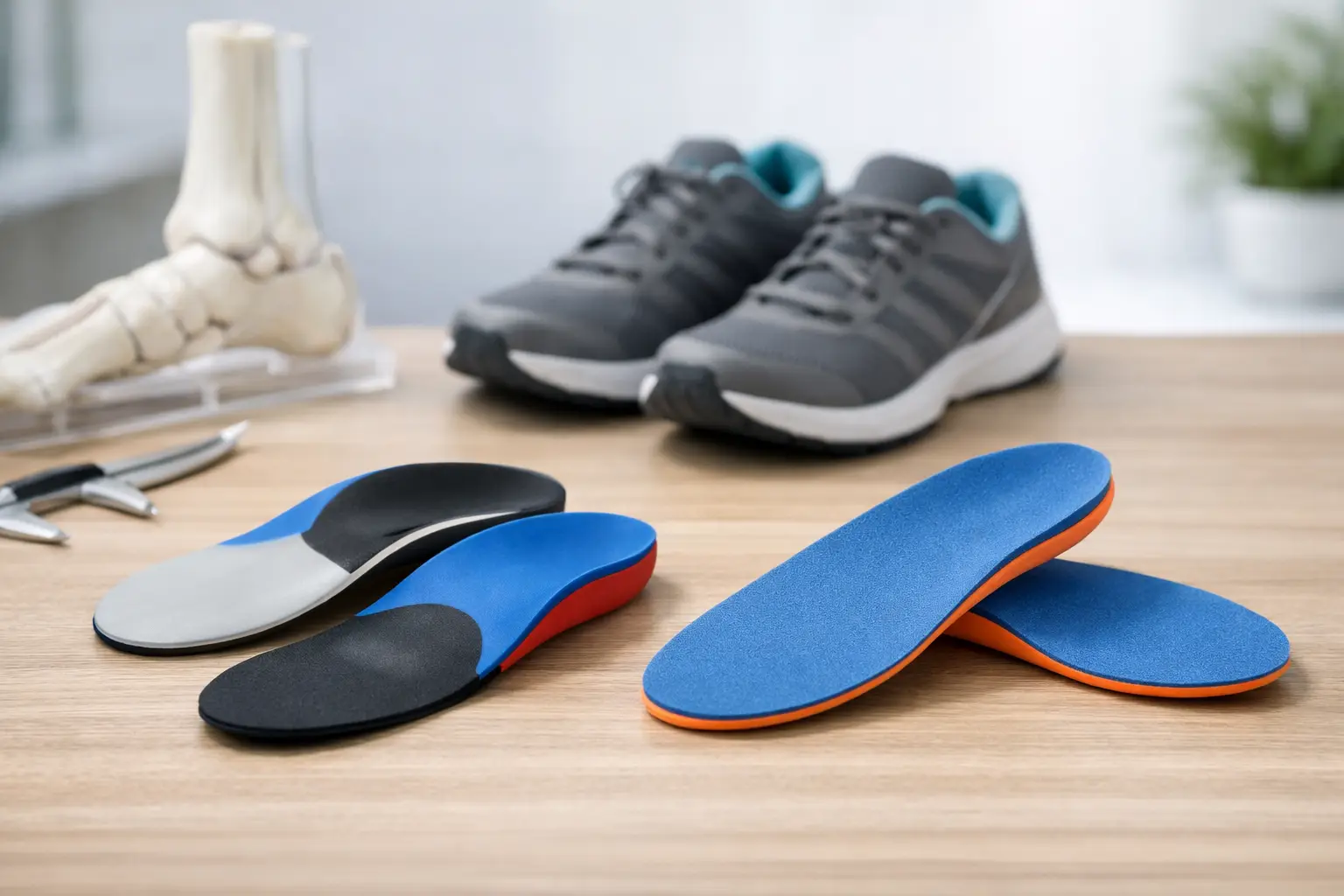
Orthotics vs Insoles for Walking
A pair of inserts can look almost identical when you take them out of the shoe. Yet for someone with heel pain, arch strain or aching legs after a short walk, the difference between the right and wrong option can be significant. When patients ask about orthotics vs insoles for walking, they are usually not asking about terminology. They want to know what will actually help them walk more comfortably and whether they need a simple cushioning aid or something more clinically targeted.
That distinction matters because not all walking pain comes from the same problem. Two people can both describe “sore feet on walks” and need very different treatment. One may do well with a well-made insole bought off the shelf. Another may be putting repetitive strain through the plantar fascia, tibialis posterior tendon or forefoot because of the way their foot functions, and that is where orthotics may have a clearer role.
Orthotics vs insoles for walking: what is the difference?
An insole is a broad term. It usually refers to an insert placed inside the shoe to improve comfort, reduce pressure or add a degree of support. Many insoles are pre-made and designed for general use. They may include soft cushioning at the heel, mild arch support or a more shock-absorbing top layer.
Orthotics are more specific. In clinical practice, orthotics are used to influence foot function, reduce stress on certain tissues and improve the way load is managed when you stand or walk. They may be prefabricated or custom made, but the key point is that they are chosen or designed for a diagnosed problem rather than general comfort alone.
Put simply, insoles are often about cushioning and fit. Orthotics are about targeted mechanical support. There is overlap, but they are not interchangeable in every case.
When a standard insole may be enough
For some people, walking discomfort is mainly due to footwear that offers very little shock absorption or internal support. This is common with very flat casual shoes, worn-out trainers and some work shoes. If your symptoms are mild, recent and mainly linked to long days on your feet, an insole may be enough to improve comfort.
A good insole can help if you feel general tiredness under the heel or ball of the foot, if your shoes feel hard underfoot, or if you want a more secure fit inside a slightly roomy shoe. Some walkers also benefit from an insole when the issue is pressure rather than faulty mechanics, for example if the skin under the forefoot becomes sore after longer distances.
That said, even a good insole has limits. It may make walking feel better without addressing why the pain started. If the symptoms return every time you increase your activity, or if one side is consistently worse, it is worth looking beyond comfort alone.
When orthotics are more appropriate
Orthotics tend to be more useful when there is a recurring pattern of overload. That might be plantar fasciitis, tibialis posterior pain, forefoot pain related to pressure distribution, or symptoms linked to instability and poor control through the foot and ankle. In those cases, simply adding a softer layer inside the shoe may not change very much.
A properly selected orthotic can help alter how force travels through the foot during walking. It can reduce excessive strain on an irritated structure, improve load sharing and support a more efficient walking pattern. This does not mean orthotics “fix” every issue. It means they can form part of a treatment plan when the diagnosis supports their use.
This is where assessment becomes important. If pain is being driven by inflammation, tendon overload, joint irritation or compensatory gait changes, the insert needs to match the condition. Otherwise, patients often spend money trying one product after another without understanding why nothing is lasting.
The problem with choosing by arch height alone
Many shop-bought products are marketed by arch type – low, medium or high. That can be useful to a point, but it is a simplified way of looking at a much more complex issue. Foot posture is only one part of the picture. The way your foot moves under load, the stiffness of your joints, your bodyweight, your walking pace, your ankle mobility and your footwear all influence what you actually need.
For example, someone with a flatter foot posture may walk very comfortably and not need any insert at all. Another person with an apparently normal arch may have persistent heel pain because of tissue overload and poor calf flexibility. Buying support based only on how the arch looks can miss the reason symptoms are happening.
The same applies to online advice that suggests softer is always better. Soft cushioning can feel pleasant at first, but in some cases it allows too much movement and does not reduce stress where it needs to. In other cases, a firmer device feels unusual for a few days but gives much better long-term relief.
What walking pain can tell you
The location and pattern of pain often give clues about whether an insole or orthotic is more likely to help. Generalised soreness after a long day may point towards cushioning and footwear changes. More specific symptoms need more careful thought.
Pain under the heel first thing in the morning may suggest plantar fascia irritation. Pain along the inside of the ankle or arch can indicate tibialis posterior involvement. Burning under the forefoot may reflect pressure overload, nerve irritation or joint pathology. If symptoms travel into the leg or change your gait, the issue may be more than a simple shoe comfort problem.
That is why a structured assessment matters. The insert should be selected after the cause of pain is considered, not before. At South London Foot Clinic, this is part of a consultation-led approach where examination comes first, and imaging such as ultrasound is used when clinically indicated to clarify the diagnosis.
Orthotics vs insoles for walking with common conditions
For plantar fasciitis, either may help depending on severity and cause. Some patients improve with a supportive prefabricated insert and better footwear. Others need a more specific orthotic approach because the fascia is being repeatedly overloaded.
For flat feet, the answer is not automatic. Flat feet without pain do not always need treatment. Flat feet with fatigue, arch pain or ankle strain may respond better to an orthotic that supports load management during walking.
For metatarsalgia, cushioning can be helpful, but the exact placement of offloading matters. A generic insole may not put pressure relief in the right place. For tendon pain, especially around the arch or ankle, support usually needs to be more intentional than a soft insert alone can provide.
For arthritis, the best option depends on which joint is affected and how stiff or irritable it is. Some patients need pressure relief and shock absorption. Others benefit more from controlling motion through a painful joint.
Why footwear still matters
No insert works well in the wrong shoe. This is one of the most common reasons patients feel disappointed after buying support online. If the shoe is unstable, too flexible through the midfoot, too narrow, or worn down unevenly, even a well-designed insert may not perform properly.
Walking shoes should hold the foot securely, have enough depth to accommodate the insert and provide a reasonably stable base. The insert and the shoe work together. If one is poor, the overall result is often poor as well.
This also explains why a device that helps in trainers may feel ineffective in lighter casual shoes. The shoe itself changes how the support behaves.
Do you need custom orthotics?
Not always. Many patients do well with a carefully chosen prefabricated orthotic, especially when the condition is straightforward and the shoe fit is suitable. Custom orthotics are more useful when the foot shape is difficult to accommodate, symptoms are persistent, previous options have failed, or a more precise mechanical correction is needed.
Custom does not automatically mean better. It means more specific. The real question is whether that level of specificity is clinically justified. A thorough assessment should answer that clearly.
If you have ongoing pain, repeated flare-ups or symptoms that are limiting your walking distance, guessing is rarely the most efficient route. A diagnosis-led plan is usually faster and more cost-effective than cycling through multiple products in the hope that one happens to work.
How to decide what is right for you
If your feet simply feel a bit tired in unsupportive shoes, a good quality insole may be a reasonable first step. If your pain is localised, recurring, affecting one side more than the other, or changing the way you walk, it is sensible to have it assessed.
The right choice depends on the tissue involved, the way your foot is loading, your activity level and the type of footwear you use day to day. Support should match the problem. That is the difference between short-term relief and a treatment plan that actually makes walking easier.
If walking has become something you work around rather than enjoy, that is usually the point to stop experimenting and get clear answers.


