


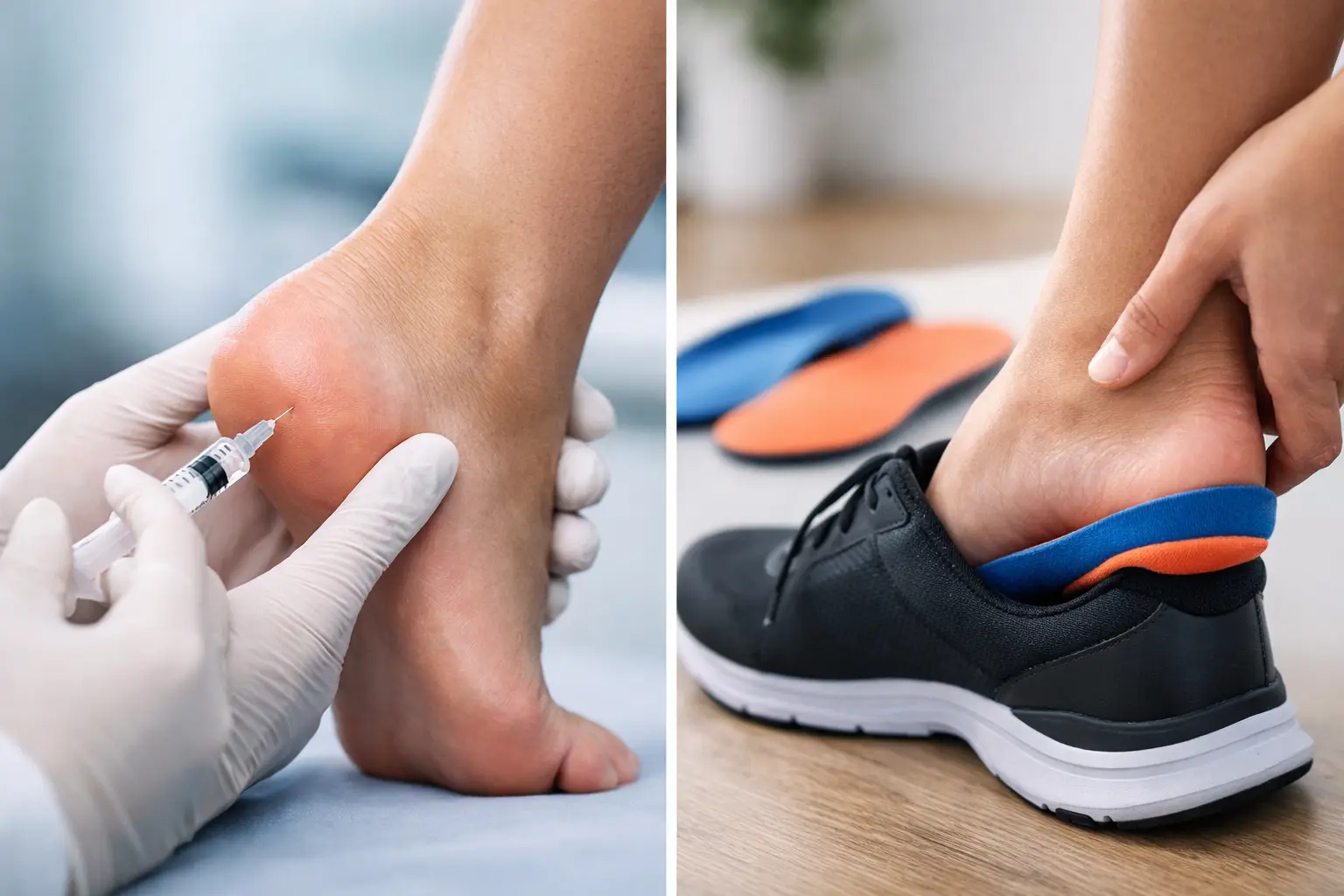
Steroid Injection vs Orthotics for Heel Pain
The first few steps from bed can be the most revealing part of heel pain. If the pain eases after a short walk but returns after standing, running or a long commute, it is often tempting to search for the quickest fix. Yet the steroid injection vs orthotics heel question cannot be answered safely without establishing which structure is painful and why it has become overloaded.
For many people, both treatments can have a place. They do different jobs, carry different considerations and are not interchangeable. A clear assessment helps determine whether heel pain is likely to settle with support and rehabilitation, whether an injection is appropriate, or whether another diagnosis needs a different plan altogether.
Why the diagnosis comes before treatment
Plantar fasciopathy is a common cause of pain under the heel. It usually involves irritation and degenerative change where the plantar fascia attaches to the heel bone, rather than a simple acute inflammation. Typical symptoms include sharp pain with first steps, tenderness on the inside of the heel and discomfort after prolonged standing or activity.
However, not every painful heel is plantar fasciopathy. Pain at the back of the heel may involve the Achilles tendon, its insertion or the bursa nearby. Nerve irritation can produce burning, tingling or pain that travels into the arch. A stress injury, fat-pad pain, inflammatory arthritis and referred pain from elsewhere in the leg also need consideration.
This distinction matters because an orthotic designed to reduce strain on the plantar fascia will not necessarily address an Achilles problem, and a steroid injection in the wrong area may be unhelpful or inappropriate. A podiatry assessment considers the exact site of pain, how symptoms started, footwear, training or work demands, joint movement, calf strength and walking pattern. Diagnostic ultrasound may be used when it will clarify the condition, assess tissues and support a more precise treatment decision.
Steroid injection vs orthotics for heel pain: different roles
An orthotic is a device worn inside the shoe to alter how force is distributed through the foot and lower limb. It may cushion a sensitive heel, support the arch, reduce pull through the plantar fascia or improve control where foot mechanics are contributing to repeated overload. Some people need a custom orthotic; others may respond to a more straightforward device or footwear change. The choice should follow the assessment rather than the assumption that custom is always necessary.
A corticosteroid injection is used to reduce pain and inflammation in selected conditions. For persistent plantar heel pain, it may offer short-term relief when symptoms remain limiting despite appropriate conservative care. It is not a repair for a weakened or overloaded tissue, and it does not remove the reason the symptoms developed.
That is why the comparison is not simply about which treatment works better. Orthotics are usually part of a load-management strategy. An injection may reduce a painful barrier that is preventing normal walking, work, sleep or rehabilitation. In suitable cases, an injection can create an opportunity to progress a broader recovery plan. Used alone, its benefit may be temporary.
When orthotics may be the more suitable first step
Orthotics are often considered where heel symptoms are linked to repeated loading, particularly when pain is aggravated by long periods on the feet, a return to running, unsupportive footwear or changes in activity. They can be useful for people who have a foot posture or movement pattern that places extra strain on the plantar fascia or surrounding tissues.
They are not instant pain relief in the way people may hope. There is usually an adaptation period, and the device needs to be worn in footwear that can accommodate it properly. The goal is not to make the foot dependent on support. It is to reduce excessive strain while symptoms settle and while strength, mobility and activity tolerance are rebuilt.
A well-planned orthotic pathway may also include calf and plantar fascia exercises, practical footwear advice, modifications to walking or sport, and a staged return to higher-impact activity. This approach is particularly relevant when symptoms are recent, manageable or clearly linked to a change in load.
Orthotics have limitations. They will not correct every cause of heel pain, and a device that is too soft, too rigid or poorly matched to the problem can be uncomfortable. Follow-up matters. Small adjustments can significantly change comfort and function.
When a steroid injection may be considered
A steroid injection may be discussed when heel pain has persisted, is substantially affecting daily life and has not improved sufficiently with an appropriate period of conservative management. It may also be considered when pain is preventing meaningful progress with rehabilitation.
The decision should be individual. Your clinician will consider the diagnosis, duration and severity of symptoms, previous treatment, medical history, medication and the tissue involved. For some patients, ultrasound guidance can help confirm the target area and support accuracy when an injection is clinically indicated.
Steroid injections can reduce pain, but they are not risk-free. Potential effects include temporary post-injection soreness, skin or fat-pad changes, infection and, in certain tissues, a risk of weakening or rupture. These risks are one reason repeated injections are approached cautiously, particularly around the plantar fascia and Achilles tendon. A steroid injection is generally not used within the Achilles tendon itself because of tendon rupture risk.
After an injection, activity may need to be reduced for a short period. The next phase should be planned rather than left to chance: supportive footwear or orthotics where needed, gradual loading, exercises and review of factors that caused the flare-up. Relief can make it easy to do too much too soon, which may allow symptoms to recur.
What treatment decisions look like in practice
A runner with first-step plantar heel pain after increasing mileage may benefit most from temporary training changes, strengthening, footwear review and an orthotic designed to manage load. If symptoms are improving, an injection may add little.
Someone whose heel pain has continued for many months, despite a structured programme and sensible activity changes, may be a candidate for an injection after reassessment confirms the diagnosis. In that setting, the injection may be one component of a planned recovery pathway rather than a last-minute shortcut.
Conversely, pain at the back of the heel in a person with Achilles insertion symptoms requires a different level of caution. The priority may be reducing compression and tendon load, altering footwear and using a progressive rehabilitation plan. Treating all heel pain as plantar fasciitis risks delaying the right care.
There is also no requirement to choose one treatment permanently. Orthotics and injection therapy are sometimes used together, but only where the clinical reasoning supports it. Other options, such as hands-on treatment, rehabilitation, shockwave therapy or alternative injection approaches, may be discussed depending on the diagnosis and response to care.
Questions worth asking at your appointment
Before agreeing to either option, it is reasonable to ask what structure is believed to be causing the pain, what findings support that diagnosis and whether imaging would add useful information. You should also understand the expected benefit, the risks, the likely recovery timeline and what you will need to do after treatment.
A clear plan should include more than a procedure or a device. It should explain how pain will be monitored, when activity can progress, what signs mean you should seek review and what will happen if improvement does not follow the expected course. At South London Foot Clinic, this is approached through consultation, assessment and ultrasound where clinically indicated, so treatment follows the diagnosis rather than assumptions.
Heel pain needs a plan, not just pain relief
The most appropriate treatment is the one that fits the tissue involved, the stage of the problem and the demands you need your feet to meet. If heel pain is persistent, recurring or stopping you from walking, exercising or working normally, a structured assessment can replace guesswork with a practical route back to comfortable movement.


