


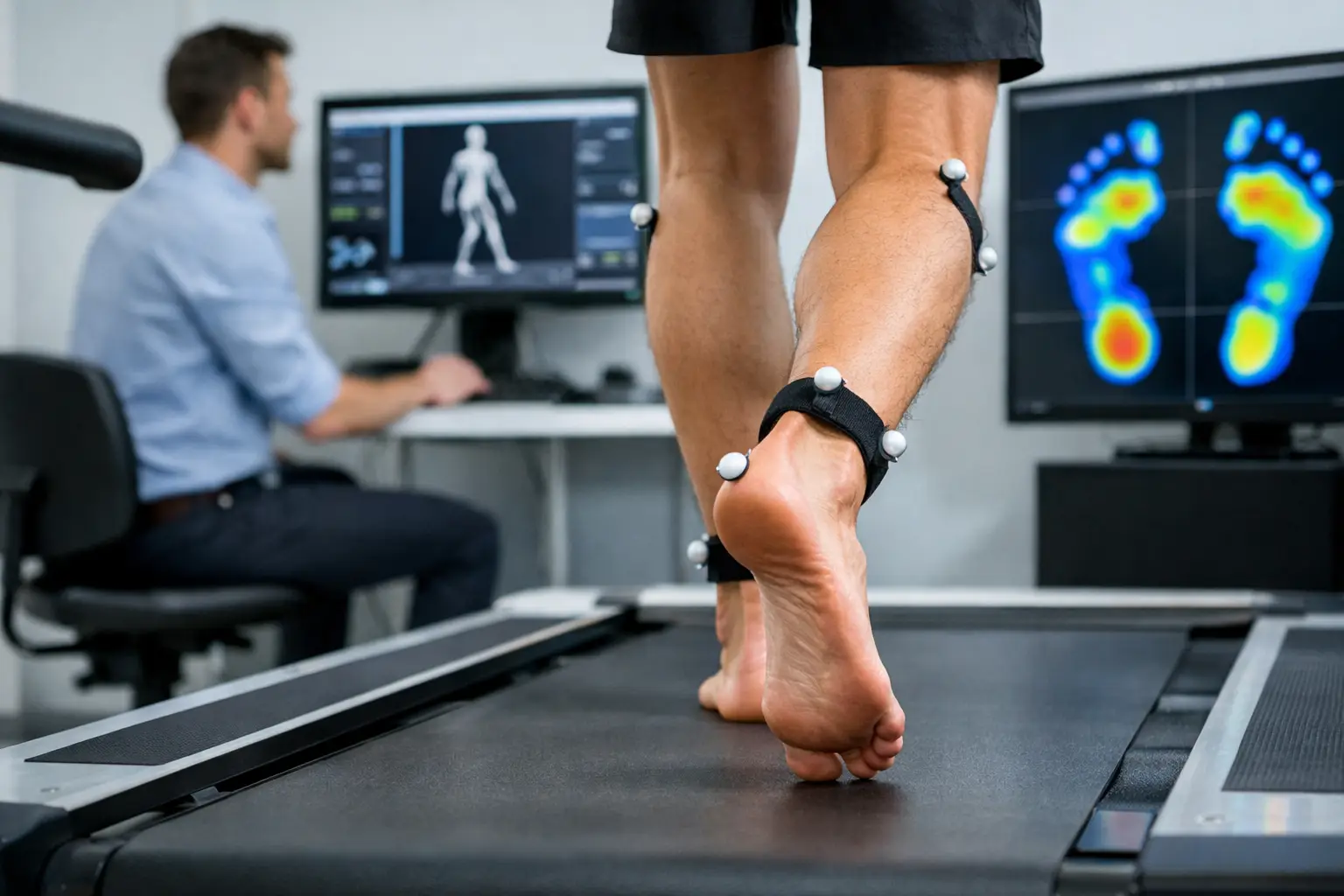
Gait Analysis for Foot Pain: What It Shows
A patient can describe heel pain perfectly, point to the exact spot, and still leave without a clear answer if nobody looks at how that foot is working under load. That is where gait analysis for foot pain becomes useful. It helps move assessment beyond where it hurts and towards why it hurts when you walk, run, stand or return to activity.
For many people, the problem is not simply the painful area itself. A sore heel may be linked to calf stiffness, reduced ankle movement, overload through the plantar fascia or a change in how the foot rolls during walking. Pain around the forefoot may be affected by toe function, footwear, joint stiffness or the way weight transfers from heel to toe. Gait analysis helps place those findings in context.
What gait analysis for foot pain actually means
Gait analysis is the clinical assessment of how you walk and, where relevant, how you run. In podiatry, it is not a stand-alone gimmick or a quick look at someone on a treadmill. Done properly, it sits within a structured examination that considers symptoms, medical history, footwear, joint movement, muscle function and tissue loading.
The aim is not to label every movement pattern as abnormal. People walk differently for many reasons, and variation alone is not a diagnosis. The key question is whether a particular walking pattern is contributing to stress on an irritated structure, limiting recovery, or developing as a compensation for another problem.
A useful gait assessment looks at timing, control and force transfer. It considers how the heel contacts the ground, how the arch behaves under load, how the ankle progresses, whether the toes are doing their job, and whether one side is working differently from the other. In some cases, the issue is obvious. In others, the detail matters.
Why walking mechanics matter when your foot hurts
Foot pain is often load-related. That means symptoms are influenced by how often a structure is stressed, how much force goes through it, and how well that tissue tolerates the demand being placed on it. Gait affects all three.
Take plantar heel pain as an example. Two patients may both have pain under the heel first thing in the morning. One may have reduced ankle dorsiflexion and overload through the plantar fascia during mid-stance. Another may be offloading the heel because of pain, changing their gait and creating secondary strain elsewhere. The symptoms can sound similar, but the management may differ.
The same applies to Achilles tendon pain, metatarsalgia, Morton’s neuroma, tibialis posterior dysfunction, arthritis-related foot pain and recurrent overload injuries in runners. If the assessment stops at the painful spot, treatment can become too generic. If gait is considered as part of the full picture, treatment planning is usually more precise.
What a clinician is looking for during gait analysis
A podiatrist is not simply watching whether you overpronate. That term is often overused and rarely explains a condition on its own. A more clinically useful assessment asks what the foot is doing, when it is doing it, and whether that pattern matches the patient’s symptoms and examination findings.
This may include how quickly the foot moves from heel strike into pronation, whether the arch remains controlled, whether the ankle joint progresses adequately over the foot, and whether the forefoot is loading evenly. The clinician may also assess step length, cadence, limb symmetry and trunk position, particularly if symptoms extend into the ankle, shin, knee or hip.
If you are a runner, gait analysis may include running-specific observations. Running places different demands on the foot and lower limb, so walking findings alone are not always enough. Equally, treadmill running can be useful, but only if the results are interpreted properly and matched with the clinical examination.
When gait analysis helps most
Gait analysis is particularly valuable when pain is persistent, recurrent or difficult to explain from static examination alone. It is also helpful where symptoms only appear during activity, or where previous treatment has not worked as expected.
Common examples include heel pain that returns as soon as activity increases, forefoot pain linked to longer walks or work shoes, tendon pain aggravated by hills or running, and lower-limb symptoms that seem to shift from one area to another. It can also help after injury, when patients have developed compensatory patterns they are no longer aware of.
That said, gait analysis is not necessary for every case. If someone has a clearly infected ingrown toenail, a straightforward corn, or a fracture that needs immediate imaging and protection, watching them walk is not the priority. Good assessment is about choosing the right tools for the problem in front of you.
Gait analysis is useful, but it is not the diagnosis
This is one of the most important points. Gait analysis can reveal contributing factors, but it does not replace clinical diagnosis. A change in walking pattern may be the cause of pain, the result of pain, or both.
For example, a patient with plantar plate injury may alter toe-off to avoid forefoot discomfort. A patient with Achilles pain may shorten their stride because the tendon is irritated. In both cases, gait changes are present, but the underlying tissue problem still needs to be identified accurately.
That is why structured examination matters. A clear diagnosis usually comes from combining history, hands-on assessment and, where clinically indicated, imaging such as diagnostic ultrasound. At South London Foot Clinic, that joined-up process helps ensure treatment is based on what is actually driving the symptoms rather than on assumptions.
How gait findings influence treatment
If gait analysis identifies a loading problem, treatment is aimed at changing the forces that are irritating the tissue while also helping the tissue recover. That may involve footwear advice, specific exercises, temporary activity modification, strapping, rehabilitation planning or custom orthotics where these are clinically justified.
Orthotics are a good example of where nuance matters. They can be very effective for some patients, especially where mechanics are contributing to repeated overload. But they are not automatically the answer to every painful foot. Sometimes the main issue is calf weakness, a stiff big toe joint, poor shoe structure or training error. In those cases, orthotics alone may only partly help or not help at all.
Equally, exercise is important but not always enough on its own if a patient continues to load the same painful structure in the same aggravating way all day. The best plans usually combine symptom reduction with a realistic change in mechanics and a staged return to normal activity.
What patients often misunderstand about gait analysis for foot pain
One common misunderstanding is that there is a single ideal way to walk. There is not. Many people have movement patterns that look slightly unusual but cause no symptoms at all. Treatment should focus on clinically relevant findings, not on trying to make every foot move in the same way.
Another misunderstanding is that a video of you walking automatically gives the answer. It does not. Technology can be helpful, but only when interpreted by a clinician who understands tissue injury, biomechanics and symptom behaviour. A slow-motion clip is useful evidence. It is not a diagnosis by itself.
Patients also sometimes assume that if gait has contributed to their pain, the problem must be permanent. Usually it is more manageable than that. Load can be modified, strength can improve, footwear can be adjusted and irritated structures can settle. The key is understanding what needs to change and what does not.
When further investigation may be needed
Not all foot pain is mechanical. If symptoms are severe, worsening, unexplained, associated with significant swelling, night pain, numbness, trauma or systemic inflammatory disease, further assessment may be required. Gait analysis can still form part of the picture, but it should not distract from more urgent diagnostic questions.
Diagnostic ultrasound can be especially useful where the clinical assessment suggests tendon pathology, plantar fascia changes, bursitis, Morton’s neuroma or other soft tissue conditions that benefit from confirmation. In those cases, seeing how the foot moves and seeing what the tissue looks like can be far more helpful than relying on either one alone.
What to expect from a proper assessment
A good assessment should leave you with more than a description of how you walk. You should come away understanding what is likely causing your pain, whether gait is contributing, what needs to change first, and what treatment options are appropriate. That process should feel clear rather than confusing.
For some patients, the next step is straightforward rehabilitation and footwear advice. For others, it may include orthotic management, hands-on treatment, image-guided care or a more structured return-to-activity plan. The important point is that treatment should follow diagnosis, not the other way round.
If your foot pain keeps returning, changes the way you walk, or never seems fully explained, gait analysis may be a useful part of getting to the bottom of it. The value is not in being told that you walk differently. The value is in understanding whether that difference matters, and what can be done about it.


