


Corns or Warts on Feet: How to Tell the Difference
A painful spot on the sole can make every step feel as though you are standing on a small stone. People searching for corns or warts feet are often dealing with exactly this uncertainty: is it pressure-related hard skin, or a viral skin lesion? The distinction matters because a corn and a verruca need different treatment. Trying to remove the wrong one at home can make the area more painful, damage healthy skin and delay proper care.
Corns or warts on feet: why they are easily confused
Corns and verrucas can both occur on weight-bearing areas such as the ball of the foot, heel or toes. Both may look like a small, circular area of thickened skin, and both can hurt when walking. However, they arise for very different reasons.
A corn is a concentrated build-up of hard skin caused by repeated pressure or friction. It is the skin’s response to a mechanical problem, often linked to footwear, a prominent joint, toe deformity, altered walking pattern or pressure beneath the forefoot. The hard skin forms a dense central core that can press into the deeper layers of skin.
A verruca is a wart on the foot caused by strains of human papillomavirus, or HPV. The virus enters through tiny breaks in the skin and can produce a rough lesion that grows inwards under pressure. Verrucas can be picked up in communal changing areas, swimming pools and showers, although contact with the virus does not always lead to an infection.
What does a corn look and feel like?
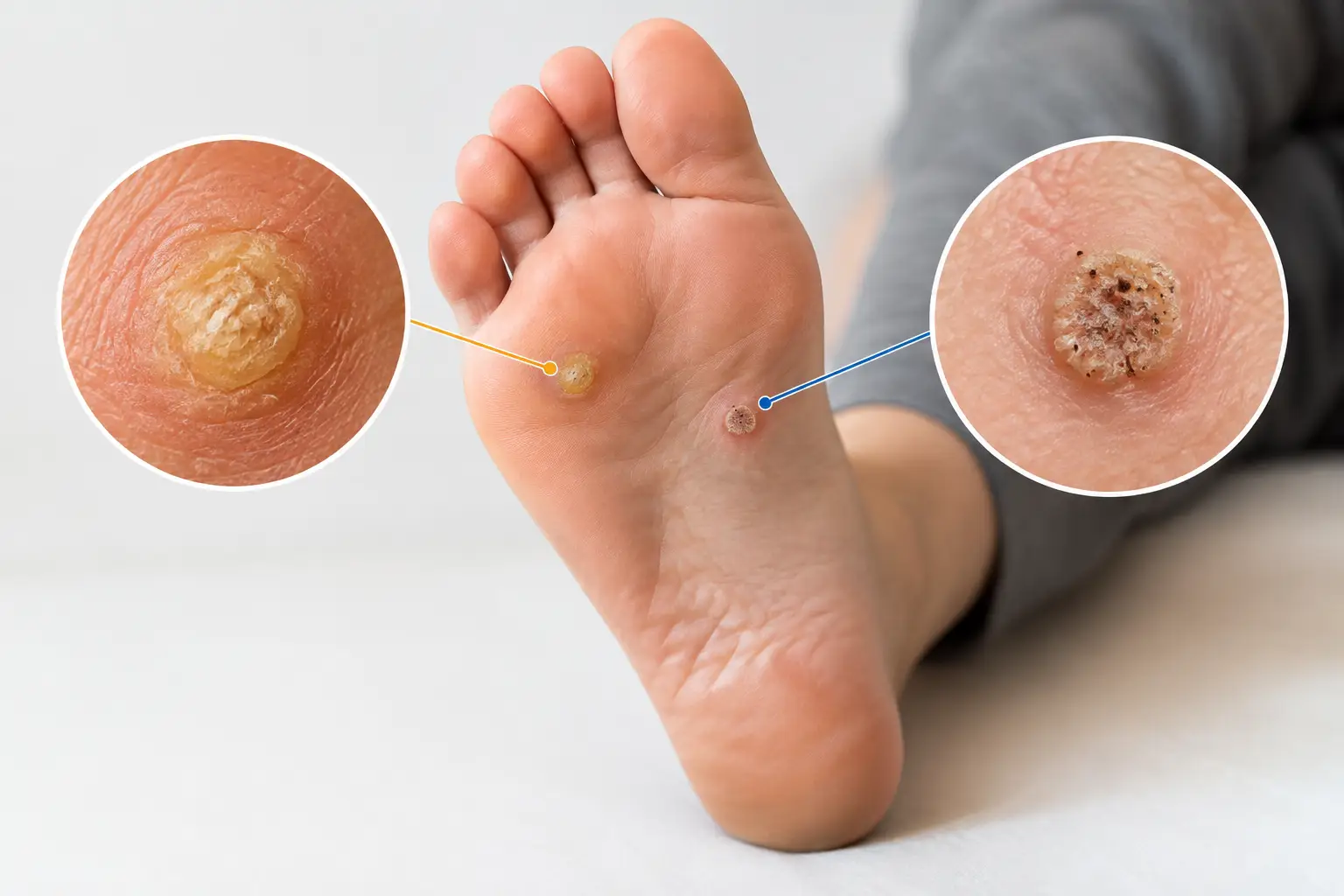
A corn is usually well defined and may appear as a small, yellowish or translucent circle within an area of dry, hard skin. It often has a firm centre. On the sole, it can be difficult to see clearly because pressure flattens the surface, but the concentrated core is usually noticeable during treatment.
Pain from a corn is commonly direct and localised. Pressing vertically down onto it can reproduce a sharp, pointed discomfort. Many people describe the feeling as walking on a pin or pebble. A corn between the toes may be softer and whiter because of moisture, but it can still be extremely tender.
Importantly, a corn does not have a contagious cause. If the pressure that created it remains, the corn is likely to return even after hard skin has been reduced. This is why treatment should consider both immediate relief and the reason that pressure is repeatedly building in that particular place.
What does a verruca look and feel like?
Verrucas vary in appearance. They may be rough and grainy, with a cauliflower-like surface, or they may be covered by a layer of hard skin that makes them look more like a corn. Small dark dots may be visible within the lesion. These are tiny clotted blood vessels, rather than roots.
The normal skin lines on the foot tend to be interrupted by a verruca. In contrast, skin lines are more likely to continue across a corn or callus. Verrucas may also occur in clusters, sometimes called mosaic verrucas, although a single lesion is common.
Pain can be different too. A verruca may be more uncomfortable when squeezed from the sides than when pressure is applied directly from above. This is a useful clue, not a reliable diagnosis by itself. Thick hard skin over a verruca, or a corn in an unusual position, can blur the usual signs.
A simple comparison
The source of the problem is the key difference. Corns are caused by pressure and friction; verrucas are caused by a virus. A corn generally has a hard central core and hurts with direct pressure. A verruca may disrupt skin lines, contain pinpoint dark dots and be more painful with a side-to-side squeeze.
There are exceptions. A verruca can sit beneath hard skin and a corn can develop in a place where it resembles a wart. Conditions such as callus, foreign-body reactions and, less commonly, other skin lesions can also be mistaken for either. Persistent uncertainty is a good reason for a podiatry assessment rather than continued self-treatment.
Why self-treatment is not always the right answer
Pharmacy treatments containing salicylic acid can be suitable for some verrucas, but they are not appropriate for everybody and should not be used on broken, inflamed or uncertain skin. Acid preparations can injure surrounding healthy tissue if applied inaccurately. They are particularly unsuitable without professional advice for people with diabetes, poor circulation, neuropathy, immune suppression or a history of foot ulceration.
Corn plasters can create similar risks. They may reduce hard skin temporarily, but they do not correct the pressure causing the corn. Cutting a lesion with blades, scissors or sharp instruments at home is also unsafe. It increases the risk of a wound, infection and deeper damage, particularly when sensation or circulation is reduced.
Do not assume that a painful lesion must be treated aggressively. Some verrucas resolve naturally, especially in children and younger adults, while others persist and affect daily activity. The sensible route depends on the diagnosis, the level of pain, duration, location and your wider health.
How a podiatrist assesses a painful foot lesion
A structured assessment begins with the history. Your podiatrist will ask how long the lesion has been present, whether it is spreading or changing, the type of pain it causes and which footwear or activities aggravate it. They will also consider relevant medical conditions, medication and circulation or nerve health.
The skin is then examined closely. Reducing overlying hard skin, when clinically appropriate, can reveal whether skin lines pass through the area, whether there are pinpoint blood vessels and whether a central corn is present. The foot’s pressure pattern, footwear and toe position may also be assessed when a corn is suspected.
At South London Foot Clinic, treatment planning follows diagnosis rather than assumption. For some painful corns, careful removal of the hard skin provides immediate relief, followed by advice or measures to reduce recurring pressure. This may include footwear changes, cushioning, toe devices or orthotic assessment where biomechanics are contributing.
For confirmed verrucas, the options depend on the lesion and the person. Treatments may include topical approaches, needling or Swift verruca treatment, which uses controlled microwave energy. No single treatment is right for every verruca, and results can take time. A clear discussion of expected response, discomfort, follow-up and alternatives helps patients make an informed choice.
When to arrange an assessment promptly
Most corns and verrucas are not emergencies, but certain changes should not be ignored. Arrange assessment promptly if a lesion bleeds without clear reason, becomes ulcerated, changes rapidly in size or colour, is increasingly painful, or shows signs of infection such as spreading redness, warmth, swelling or discharge.
You should also seek professional advice before using over-the-counter treatments if you have diabetes, impaired circulation, reduced sensation, an autoimmune condition or take medication that affects immunity. What appears to be a minor hard-skin problem can carry more risk when healing is compromised.
If you have already tried treatment for several weeks without improvement, or a lesion repeatedly returns, an examination can prevent further trial and error. The aim is not simply to remove what is visible, but to identify whether infection, pressure or another cause is keeping the problem active.
A painful spot on your foot deserves a clear explanation. Once you know whether it is a corn, a verruca or another skin condition, treatment can be chosen with greater confidence and with a realistic plan for keeping you comfortable on your feet.


