


Best Exercises for Ankle Stability at Home
A rolled ankle rarely feels like a one-off problem. Even after the swelling settles and walking becomes comfortable, many people notice that the ankle still feels unreliable on uneven ground, stairs or during exercise. The best exercises for ankle stability help rebuild the strength, balance and joint control that reduce this sense of giving way.
The right programme depends on the cause of your instability. A recent sprain, longstanding recurrent sprains, tendon pain, reduced ankle movement and poor balance can all produce similar symptoms, but they do not always need the same approach. Exercises are most useful when they are progressed at the right pace rather than pushed through pain.
Why ankle stability needs more than strengthening
The ankle is not stabilised by one muscle alone. The calf muscles control how the shin moves over the foot, while the smaller muscles around the outside and inside of the ankle react to changes in surface and direction. Your foot, hip and nervous system also play a part in keeping you upright.
After an ankle sprain, the ligaments may heal but the body can lose some of its ability to sense joint position and respond quickly. This is why an ankle may feel weak despite having little pain. A useful rehabilitation plan combines range of movement, calf strength, resistance work and balance training.
You should be able to complete the early exercises with no more than mild discomfort. Sharp pain, increasing swelling, a feeling that the ankle is catching or locking, or repeated episodes of giving way warrant a proper assessment before progressing. This is particularly relevant if symptoms have persisted for several weeks or followed a significant injury.
Best exercises for ankle stability: a sensible progression
Start with the simplest version that you can control well. Quality matters more than repetitions. For most people, two to four sessions each week is a realistic starting point, allowing recovery between more demanding strength sessions.
Restore ankle movement with knee-to-wall reaches
Limited ankle bend can alter your walking pattern and make balance work harder. Stand facing a wall with one foot in front. Keeping the heel down and the knee tracking over the second toe, gently move the knee forwards towards the wall. The foot should not roll inwards and the movement should feel like a stretch rather than a pinch at the front of the ankle.
Perform 8 to 12 controlled repetitions on each side. Move the foot slightly farther from the wall only if the heel stays grounded and the knee remains controlled. This exercise is often helpful after a period in supportive footwear or reduced activity.
Build calf capacity with heel raises
The calf is a major contributor to ankle control during walking, running and stair climbing. Begin with double-leg heel raises, holding a worktop or wall lightly for balance. Rise steadily onto the balls of both feet, pause briefly, then lower slowly until the heels return to the floor.
Aim for two or three sets of 10 to 15 repetitions. When this is comfortable, progress to single-leg heel raises on the affected side. Keep the heel moving straight upwards rather than allowing it to drift outwards. A slow lowering phase is particularly valuable, but it should not provoke sharp Achilles or heel pain.
Strengthen the outer ankle with resistance-band eversion
The muscles on the outside of the lower leg, known as the peroneals, help resist the inward roll that commonly causes a lateral ankle sprain. Sit with the leg extended and loop a resistance band around the forefoot, anchored so that it pulls the foot inwards. Move the foot outwards against the band, then return slowly.
Keep the movement at the ankle rather than turning the whole leg. Complete two or three sets of 12 to 15 repetitions with a resistance that feels challenging towards the end of each set. If the outside of the ankle is tender following a recent injury, begin with a lighter band and a smaller range.
Improve inner ankle control with resisted inversion
The muscles on the inside of the ankle help support the arch and control the foot as weight transfers through it. Set up the band to pull the foot outwards, then draw the forefoot inwards against resistance. The heel should remain relatively still.
This exercise is not a substitute for assessment where there is pain or swelling along the inner ankle, especially if the arch has changed shape. In that situation, loading the area aggressively without a diagnosis can aggravate a tendon problem.
Practise single-leg balance before making it harder
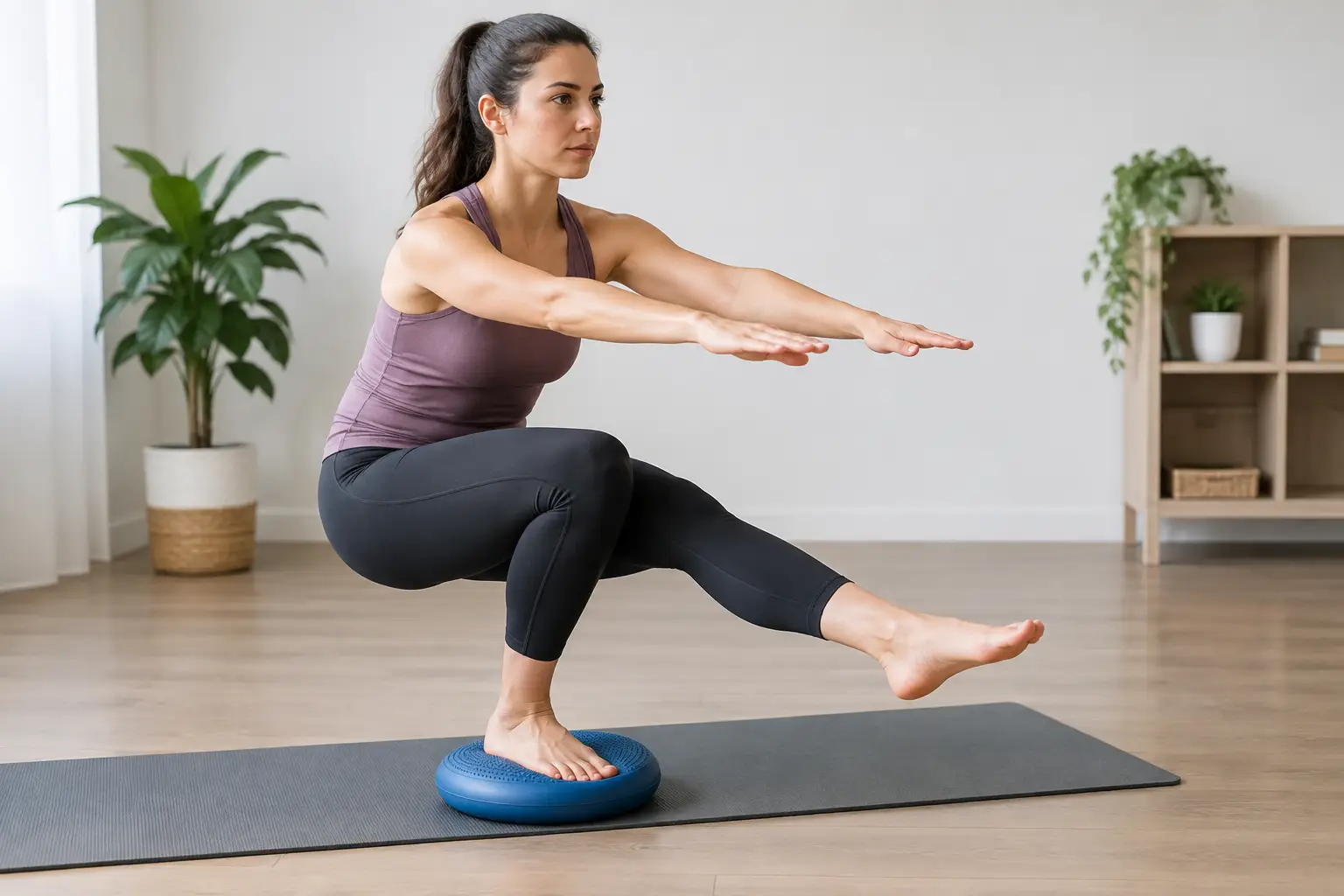
Stand near a kitchen worktop or sturdy chair, using one or two fingers for support if needed. Lift one foot and balance on the other for 20 to 30 seconds. Keep the pelvis level, maintain a soft bend in the knee and let the foot make small natural adjustments rather than gripping with the toes.
Repeat three times on each side. Once you can do this confidently, reduce hand support, turn your head slowly from side to side or stand on a firmer folded towel. Closing your eyes or using an unstable surface can be useful later, but only when basic single-leg control is secure. Making balance exercises difficult too soon often teaches compensation rather than stability.
Add controlled reach work
For a more functional challenge, stand on one leg and reach the other foot gently forwards, diagonally forwards and to the side, tapping the floor each time. Return to the starting position without the standing knee collapsing inwards or the foot rolling towards its arch.
Complete five to eight reaches in each direction. This develops the ability to control the ankle while the body moves over it, which is more relevant to daily activities than balancing perfectly still. Runners and people returning to court or field sports can later progress to small hops, direction changes and sport-specific drills, provided walking, heel raises and single-leg balance are pain-free.
How to choose the right level of exercise
A recent ankle sprain may need a short period of protection and swelling management before higher-load exercise begins. If you can walk with only mild discomfort, simple movement and light calf work are often appropriate. Hopping, running and uneven ground should wait until the ankle has regained strength and balance.
For longstanding instability, the challenge is usually consistency and progression. Repeating only easy band exercises for months is unlikely to prepare the ankle for a quick step off a kerb or a change of direction. Gradually increasing load, reducing support and introducing movement is what builds useful confidence.
Pain is a guide, not something to ignore. Mild muscular effort or a temporary awareness around a previously injured ankle can be acceptable. Pain that worsens during the session, swelling that increases afterwards, or symptoms that remain aggravated the following day suggest the exercise was too demanding. Reduce the range, repetitions or resistance and reassess.
When ankle instability needs clinical assessment
Exercise cannot identify whether instability is caused by ligament damage, tendon injury, joint irritation, a fracture that was missed at the time of injury, or reduced movement elsewhere in the lower limb. Assessment is advisable if you have persistent swelling, pain over bone, a marked loss of movement, numbness, repeated sprains or an ankle that gives way despite rehabilitation.
At South London Foot Clinic, assessment focuses on how the foot and ankle move, load and respond during everyday activity. Diagnostic ultrasound may be used where clinically indicated to examine relevant soft tissues and support a clearer treatment plan. This helps ensure that rehabilitation, orthoses or other treatment is matched to the source of the problem rather than based on symptoms alone.
A stable ankle is built through repeated, well-controlled practice. Begin with the exercise level you can perform confidently, progress only when the ankle copes well afterwards, and seek assessment when the joint continues to feel unreliable.


