


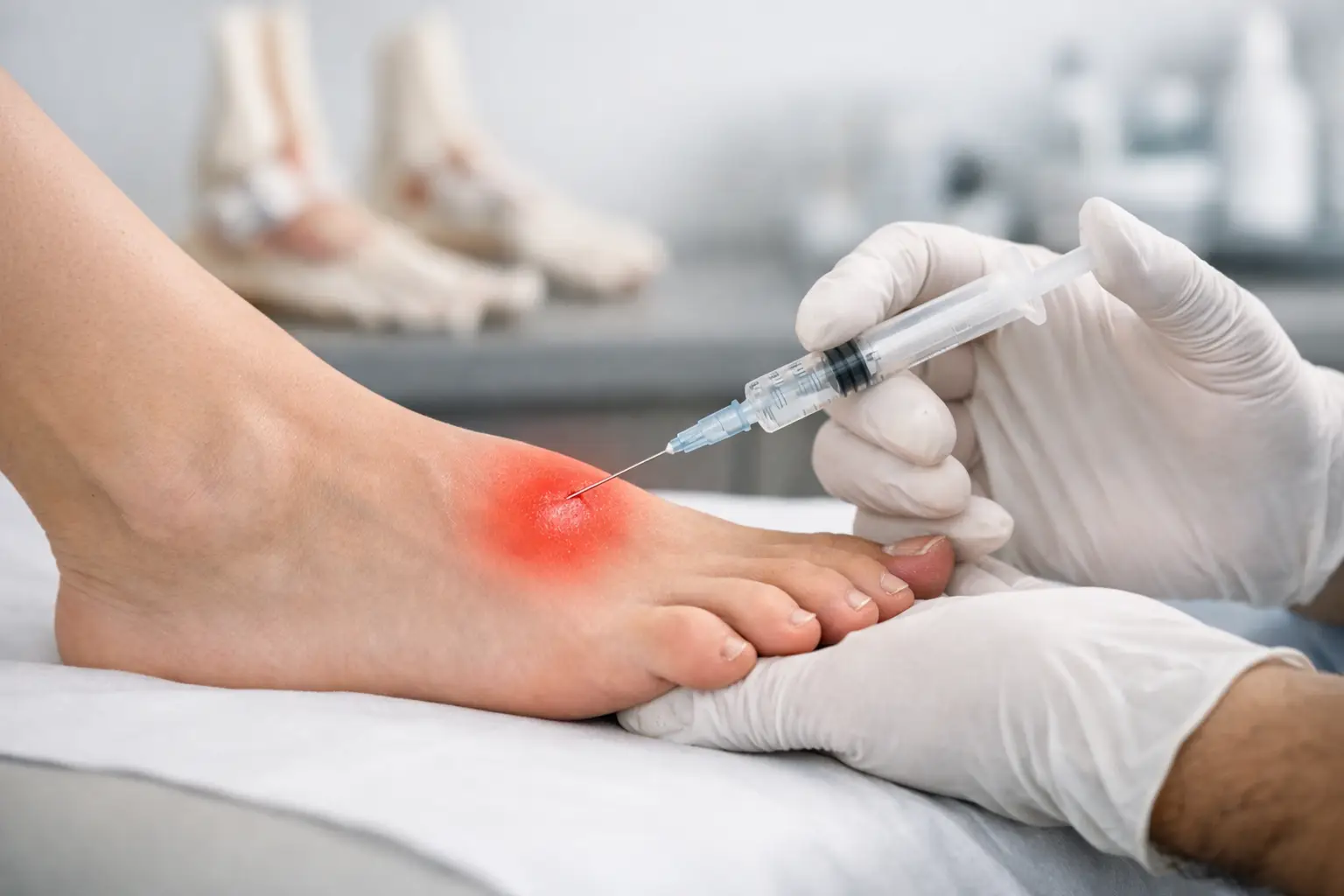
How Foot Injections Relieve Inflammation
Pain beneath the heel on first steps, a swollen joint that will not settle, or persistent soreness around a tendon can make everyday walking feel uncertain. Understanding how foot injections relieve inflammation starts with identifying the precise structure causing symptoms. An injection is not a general solution for foot pain. It is a targeted treatment used when clinical assessment shows that inflammation is a significant part of the problem and a suitable injection is likely to support recovery.
How foot injections relieve inflammation
Inflammation is the body’s response to tissue irritation or injury. In the foot and ankle, it can affect joints, tendon sheaths, bursae and the tissues around nerves. It may cause pain, warmth, swelling, stiffness or sensitivity when footwear presses on the area. In some conditions, inflammation settles with rest, footwear changes, rehabilitation and activity modification. In others, it becomes persistent and continues to limit walking, work or sport.
The injection most often used to address local inflammation contains a corticosteroid medicine, sometimes combined with local anaesthetic. Corticosteroid is a strong anti-inflammatory medicine. When placed around the affected tissue or into an appropriate joint, it can reduce the local inflammatory response. As swelling and chemical irritation reduce, pain may ease and movement may become more comfortable.
The local anaesthetic, where used, can give short-term pain relief. This may also provide useful diagnostic information. If numbing a carefully selected area produces a clear temporary reduction in symptoms, it supports the view that the treated structure is contributing to the pain. The steroid itself usually takes longer to have an effect, often over several days, though individual responses vary.
An injection does not repair a tendon tear, correct a fracture, remove a mechanical pressure point or reverse every long-standing change in a joint. Its role is to calm an inflammatory flare so that the underlying cause can be managed more effectively. This distinction is central to good treatment planning.
Conditions where an injection may be considered
Foot injections can be considered for several diagnosed conditions, but the correct approach depends on the tissue involved, symptom history and examination findings. Examples may include inflammation within a joint affected by arthritis, an inflamed bursa, certain nerve-related pain syndromes such as Morton’s neuroma, or inflammation around a tendon sheath.
Heel pain is more nuanced. Plantar heel pain is frequently described as plantar fasciitis, but the plantar fascia may show degenerative change rather than active inflammation, particularly when symptoms have persisted for months. A steroid injection may be appropriate for some patients, but it is not automatically the best first treatment and must be weighed against potential risks to the fascia and surrounding fat pad.
Similarly, steroid injection close to or within some tendons may not be suitable because corticosteroids can affect tendon tissue. This is why a diagnosis based only on the location of pain is not enough. Two people with pain in the same part of the foot can have different underlying conditions and need different treatment pathways.
Why diagnosis comes before treatment
A structured assessment helps determine whether inflammation is present, where it is located and what is driving it. Your clinician will usually discuss how symptoms began, the activities and footwear that aggravate them, previous injuries, health conditions and any treatment already tried. They will then assess walking, foot and ankle movement, joint stability, tenderness and the response of specific tissues to loading.
Diagnostic ultrasound may be clinically indicated when a closer view of soft tissues is needed. It can help assess structures such as tendons, plantar fascia, bursae, joints and some nerve-related areas. Ultrasound can identify signs that support inflammation, including fluid around a tendon sheath or bursa, while also showing thickening, degeneration or a partial tear that may change the treatment decision.
At South London Foot Clinic, the aim is to consult, scan where appropriate, discuss the findings and then agree a treatment plan that fits the diagnosis. This avoids treating a suspected problem with an injection before there is enough clarity about the tissue involved.
Targeting the right structure matters
The benefit of an injection relies partly on accurate placement. The foot contains many small joints, tendons, nerves and soft-tissue spaces in a compact area. A treatment placed near, rather than at, the relevant structure may be less effective and may expose adjacent tissues to unnecessary medicine.
Ultrasound guidance can be useful for selected injections because it allows the clinician to see the target area and guide the needle in real time. It is particularly valuable where anatomy is small, deep or close to important structures. Guidance is not required for every injection, but when it is clinically justified, it can improve confidence that treatment is being delivered precisely.
What to expect during and after a foot injection
Before treatment, the clinician should explain the proposed medicine, the reason for the injection, expected benefits, alternatives and relevant risks. You should have time to ask questions and decide whether the treatment feels appropriate for you.
The skin is cleaned carefully and the injection is delivered using a fine needle. Most injections are brief, although the area may feel sore or pressured during treatment. If ultrasound guidance is used, gel is applied and the clinician watches the needle position on screen.
Afterwards, the area can be tender for a day or two. Some people experience a temporary increase in pain, often called a post-injection flare, before the steroid begins to work. The clinician may advise relative rest for a short period, particularly after an injection around a joint, bursa or other weight-bearing structure. This does not necessarily mean complete inactivity. It means avoiding the activity that repeatedly provokes symptoms while the tissue settles.
The relief achieved varies. Some patients notice substantial improvement that lasts for months; others gain a shorter period of reduced pain or little benefit at all. The response depends on the diagnosis, the degree of tissue change, ongoing mechanical load and whether the wider rehabilitation plan is followed.
Injections work best as part of a treatment plan
Reducing inflammation can create a valuable window for rehabilitation, but the factors that contributed to the problem still need attention. Depending on the diagnosis, this may include changes to footwear, temporary activity adjustment, exercises to restore strength and movement, orthotics to alter pressure or loading, or treatment for a biomechanical issue.
For example, an injection for an inflamed forefoot joint may make walking more comfortable, but shoes that compress the toes can continue to irritate the area. An injection for a painful tendon sheath may reduce swelling, but a rapid return to high-load running without progressive strengthening can bring symptoms back. The most useful plan connects symptom relief with a realistic route back to normal activity.
Repeat injections also require careful judgement. More treatment is not always better. Repeated corticosteroid exposure in the same area can carry additional risks, depending on the tissue and medicine used. If pain returns quickly, the priority is usually to reassess the diagnosis and the load on the tissue rather than simply repeat the procedure.
Understanding the risks and when injections are not suitable
Foot injections are commonly used in clinical practice, but they are medical procedures and carry risks. These include temporary pain flare, bruising, bleeding, skin colour change, thinning of the skin or local fat tissue, infection and an incomplete response. There can also be tissue-specific risks, such as weakening of a tendon or plantar fascia in circumstances where steroid is not well suited.
Your wider health matters too. Diabetes may require additional planning because steroid can temporarily affect blood glucose levels. Blood-thinning medicines, active infection, allergies, immune suppression and previous reactions to injections should all be discussed. Pregnancy, other medicines and relevant medical history may also influence whether treatment is advised.
The right question is not simply whether an injection can reduce pain. It is whether it is the safest and most useful option for your particular diagnosis, at this stage of recovery. A clear assessment gives you the information needed to make that decision with confidence.


