


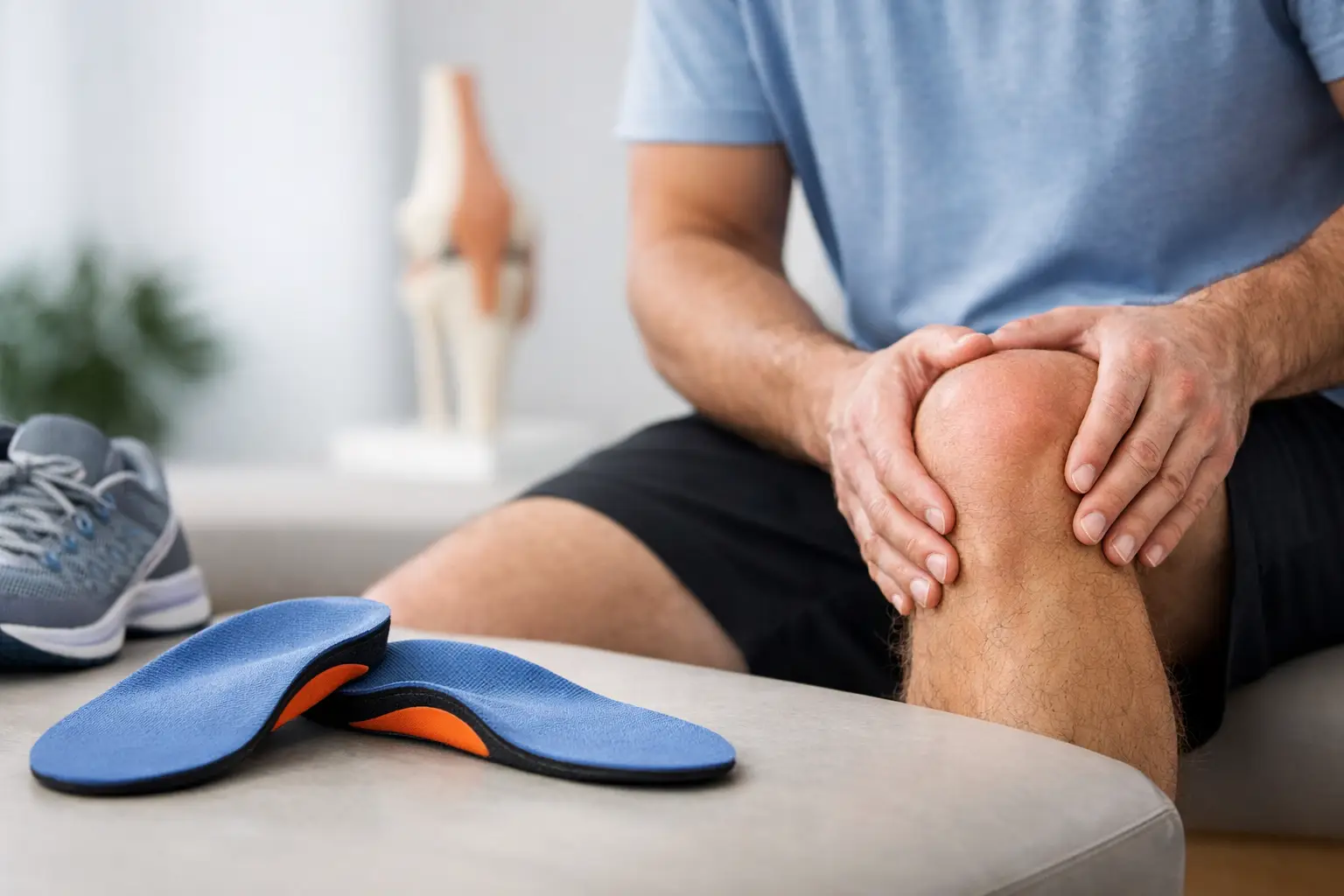
Can Orthotics Help Knee Pain?
Knee pain does not always start at the knee. A runner with pain around the kneecap, a parent struggling on the stairs, or someone whose knee aches after long walks may be surprised to hear that foot mechanics can play a part. That is why the question can orthotics help knee pain is worth answering carefully rather than with a simple yes or no.
Orthotics can help in the right circumstances. They can also be the wrong treatment if the real issue sits elsewhere. The key is understanding whether the way your foot moves, loads and transfers force up the leg is contributing to the pain you feel at the knee.
Can orthotics help knee pain in every case?
No. Knee pain has many possible causes, and not all of them relate to the foot. Arthritis, meniscal irritation, ligament injury, tendon pain, referred pain from the hip, and overload from training changes can all produce similar symptoms. Some patients benefit from orthotics because their foot function is placing extra stress on the knee. Others need strengthening work, changes in activity, footwear advice, injection therapy, or onward referral.
This is where assessment matters. If you are given insoles without a proper examination, there is a risk of treating the wrong problem. A structured lower-limb assessment looks at where the pain is, what brings it on, how long it has been present, and how your joints and soft tissues are working together.
How foot mechanics can affect the knee
The foot is your first point of contact with the ground. Each step creates force that travels through the ankle to the knee and above. If the foot rolls in excessively, remains too rigid, or loads unevenly, that can alter the way the leg rotates and how pressure is distributed at the knee.
A common example is patellofemoral pain, which tends to cause aching around or behind the kneecap. In some people, excessive pronation can contribute to inward rotation through the lower limb, changing tracking forces at the patella. In others, poor shock absorption or asymmetrical loading may increase irritation along the inside or outside of the knee.
That does not mean foot posture is always the cause. Plenty of people with flat feet have no pain at all, and some with very neutral foot mechanics still develop knee symptoms. The relationship is not as simple as one foot shape equals one knee problem. What matters is how your foot functions during walking and standing, and whether that pattern matches your symptoms.
When orthotics are most likely to help
Orthotics are usually most useful when there is a clear mechanical link between the foot and the knee. That may include people with overpronation, functional limb asymmetry, poor pressure distribution, or pain that reliably worsens with prolonged standing, walking or running.
They can also help when footwear alone is not providing enough control, or when a patient is trying to return to activity after repeated flare-ups. In these cases, an orthotic is not there to force the foot into a perfect position. It is there to improve load management, reduce irritation and make movement more efficient.
For some patients, the benefit is quite noticeable. Pain settles more quickly after activity, stairs become easier, and tolerance for walking improves. For others, the effect is more modest but still useful, especially when combined with calf work, glute strengthening and changes to training load.
Can orthotics help knee pain caused by arthritis?
Sometimes, yes, but again it depends on the pattern of arthritis and the way you load the limb. If knee osteoarthritis is being aggravated by altered alignment or uneven force through the lower limb, orthotics may help reduce strain and improve comfort during walking.
They are not a cure for arthritic change, and they will not rebuild cartilage. What they may do is improve how force is distributed and reduce the mechanical aggravation that keeps symptoms active. Some patients feel better with a simple modification. Others need a broader treatment plan that may include exercise, weight management, footwear changes or medical intervention.
What orthotics actually do
Orthotics are not just padded insoles. A properly prescribed device is designed around your foot shape, movement pattern, symptoms and activity level. The aim may be to guide motion, improve stability, offload a painful structure, or alter the timing and direction of force through the lower limb.
That is why different patients need different designs. A runner with lateral knee pain will not necessarily need the same orthotic as someone with medial compartment knee arthritis. Materials, contour, posting and flexibility all matter. The design should reflect the diagnosis rather than follow a generic template.
In clinical practice, orthotics tend to work best when they are part of a treatment plan rather than the entire plan. If your hip strength is poor, your training load has doubled, and your footwear is worn out, an orthotic alone is unlikely to solve everything.
Assessment comes before treatment
The strongest clinical question is not simply can orthotics help knee pain, but why is your knee hurting in the first place. A good assessment should identify whether the foot is likely to be a meaningful driver of symptoms or just an unrelated finding.
That process usually involves looking at your pain history, checking the knee itself, assessing foot posture and function, reviewing walking pattern, and considering the ankle, calf and hip. In some cases, imaging is appropriate if the presentation is unclear or if a soft tissue structure needs closer evaluation. Diagnostic clarity matters because it prevents guesswork.
At South London Foot Clinic, the approach is built around consult, scan, discuss, treat. That means treatment decisions are based on findings rather than assumptions. If orthotics are appropriate, they should be recommended for a clear reason. If they are unlikely to help, patients should be told that clearly as well.
What improvement should you expect?
Orthotics should not be judged after a single afternoon. Most people need a short adaptation period while the body adjusts to a change in loading. That said, you should still have a clear sense of what success looks like. For knee pain, that may mean reduced pain during walking, less discomfort after exercise, better tolerance of stairs, or fewer flare-ups over several weeks.
If there is no meaningful change after an appropriate trial, the plan should be reviewed. The diagnosis may need refining, the orthotic may need adjustment, or another treatment approach may be more relevant. Good care is not about persisting with the same intervention simply because it was prescribed.
When orthotics are unlikely to be enough
If the knee is swollen, locking, giving way, or painful after a specific injury, orthotics may be a very small part of the picture or not relevant at all. The same applies when pain is coming from a more advanced joint problem, an acute tendon issue, or referred pain from elsewhere.
There are also cases where the foot does contribute, but exercise-based rehabilitation is equally important. If the muscles around the hip and knee are not controlling load well, symptoms often return unless that is addressed. Orthotics can reduce stress, but they cannot build strength or restore conditioning.
The practical takeaway
Orthotics can be helpful for knee pain when the mechanics of the foot and lower limb are part of the problem. They are most effective when prescribed after a proper assessment, matched to a clear diagnosis and combined with other treatment where needed.
If your knee pain has been persistent, recurring or difficult to explain, it is worth looking beyond the knee itself. A thorough lower-limb assessment can show whether orthotics are likely to help, or whether a different pathway would make more sense. The reassuring part is that you do not need to guess. With the right examination, the next step usually becomes much clearer.


